Volunteer managers often know the difference their organisation makes — but struggle to evidence it in ways that funders, trustees, and partners trust.
This practical masterclass explores how volunteer-led, community organisations can move from stories and activity counts to clear, credible evidence of impact — without over-complicating things or becoming an evaluation expert.
Drawing on real examples from community organisations, the session will show how better impact evidence can strengthen funding applications, increase confidence in conversations with partners, and support smarter decisions internally.
The focus is on practical, proportionate approaches that work for small and medium-sized organisations where time and capacity are limited.
Who are Patchworks?
We help community organisations (local VCSE) to produce independent evidence of their impact.
Using a process called Covaluation – coproduced evaluation – we codesign outcomes around how you work, help you collect the data needed to prove them, and produce a brilliant report that will help you improve services and raise more funds.
Most of the organisations we work with have volunteers at their core, and measuring the social value of their contribution is crucial.
PatchWorks is the creation of Paddy Hanrahan, an experienced leader in the UK volunteering space.
Not a TeamKinetic user? No problem. You can still join us for this Masterclass via our Eventbrite page! Tickets are free for everyone.
We all know that a simple “thank you” goes a long way, but in the busy world we live in, it’s easy for volunteer reward and recognition to slip to the bottom of the to-do list. However, acknowledging the time, skills, and emotional energy your volunteers give is actually the backbone of a healthy and sustainable programme.
By acknowledging the time, skills, and emotional energy volunteers give, you’re doing more than just being polite; you’re making a strategic investment in your organisation’s future.
Why recognition matters more than you might think
Most people volunteer for altruistic reasons. They want to help or feel a personal connection to a cause. However, as Ruth Leonard and Jurgen Grotz note, while people aren’t usually hunting for thanks, they certainly notice if it’s never given!
‘Most of us like to be appreciated and recognised for what we’ve done. This doesn’t mean that people are consciously looking for thanks, rather that it becomes noticed if it’s never given. Probably, the most important thing that can be done in order to continue a relationship with volunteers is to make sure they know that they and what they do are valued.’
Focusing on appreciation isn’t just a “nice” thing to do; it makes great business sense, too. It leads to:
Lower Turnover: Volunteers stay longer, which means you spend less time and money on constant recruitment and onboarding. NCVO’s Time Well Spent research found that 81% of satisfied volunteers plan to continue over the next year, compared to just 26% of dissatisfied ones.
A Supportive Community: When you recognise volunteers, they start to recognise each other, creating a friendly, reciprocal environment.
Better Results: High engagement usually leads to better outcomes for the people or communities you serve.
Attract Younger Talent: Recognition is especially important to younger volunteers. While 40% of all volunteers value it, that number jumps to 49% for those aged 18–24.
Simple Ways to Say Thanks
You don’t need a massive budget to make someone feel valued. In fact, research shows that the most popular form of recognition is just a verbal or written thank you.
Personalised Notes: A quick email or a handwritten letter can mean the world.
Validation from the Top: Having a thank-you note come from a senior leader or the head of your organisation can make a volunteer feel their work is being noticed by the whole charity, not just their immediate supervisor.
Tangible Proof: Certificates remain a classic and effective way to celebrate a job well done.
Keeping it Legal: The Tax Bit
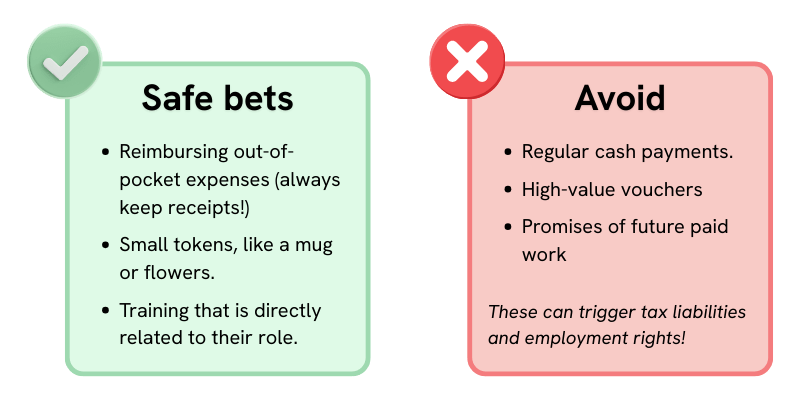
Before you start handing out gifts, it’s important to keep HMRC in mind. To avoid accidentally creating an employment relationship, rewards should be occasional, low-value, and unexpected.
Making it Easier with TeamKinetic
If you use the TeamKinetic system, there are some built-in tools that can help you automate these “thank yous” so they don’t get forgotten. If you use other tools, you can still use these ideas as a blueprint for your own recognition strategy.
The “Ice Cream Sundae” of Feedback
We love this metaphor for giving great feedback. Rather than a “cookie-cutter” message, try layering your appreciation like a sundae:
The First Scoop: The base—a simple “thank you” for their time.
The Sprinkles: A personal detail about something they did well (e.g., “You were so helpful with the registration desk today!”).
The Cherry on Top: A warm invitation to come back again soon.
Milestone Badges (Gamification)
You can create Custom Award Badges for anything you like—from “Volunteer of the Month” to “Length of Service” milestones. Some organisations get creative, using nature-themed badges where a new volunteer starts as a “Seed” and grows into a “Veteran Tree” over time. These digital badges appear on the volunteer’s profile as a permanent record of what they’ve achieved.
HourTrades: Exchanging Time for Perks
HourTrades allow volunteers to “swap” the hours they’ve logged for small rewards.
What to offer: This could be some branded kit, like t-shirts or mugs, or even better, training opportunities like a first aid course or a coaching qualification.
How it works: You set the “price” (e.g. 10 hours for a t-shirt), and the system handles the request for you.
High-Value Perks at No Cost
Through our integrations, you can offer some pretty cool perks without spending a penny of your own budget:
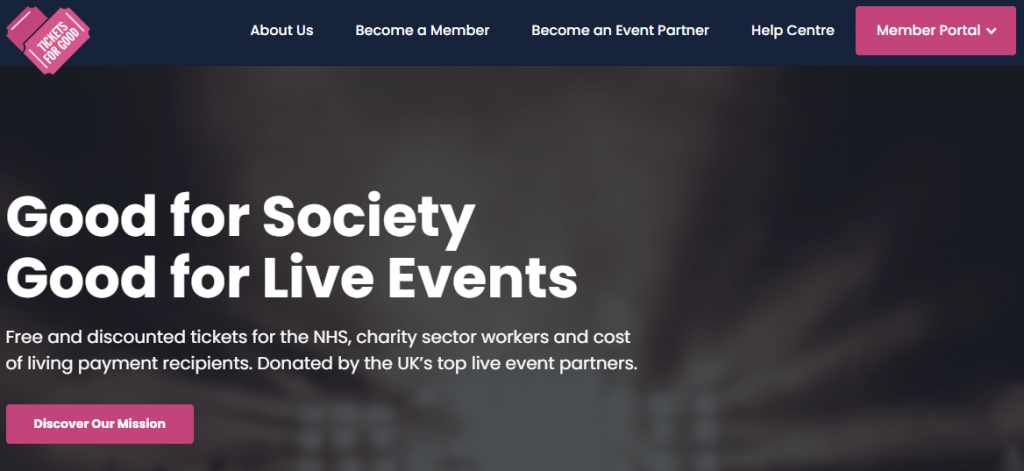
Tickets for Good Gives volunteers who have logged a set amount of hours access to free/discounted tickets for live music, comedy, and sports events.
Tempo Time Credits A national scheme where volunteers earn credits in exchange for volunteering hours. They can then spend credits on various experiences.
Are you a visual learner?
In this recent TeamKinetic masterclass, Rolf went through some of the most effective way to thank you volunteers. He shows you how to use TeamKinetic to effectively reward and recognise your volunteers.
Final Thoughts
At the end of the day, you don’t need any fancy methods of reward and recognition. You just need to be consistent and sincere. Whether you’re sending quick feedback after they’ve completed an opportunity or setting up a badge system for long-term achievements, the goal is to make sure your volunteers know that what they do truly matters.
If you’re a TeamKinetic user, why not jump into your super admin menu today and try creating your own Achievement Badges or add some HourTrade vouchers? If you aren’t using the system yet, why not contact us to see how we can help you.
What’s next?
Next up in our Masterclass series, we’re joined by Tobi Johnson. Tobi is an expert in all things volunteer management and has been sharing her wisdom via VolunteerPro since 2015. She’s joining us to discuss how to re-engage lost volunteers. Or, in her words, “How to Plan a Wildly Successful Volunteer “Win-Back” Campaign”!
TeamKinetic users can book now via their system (Help & Support → Masterclasses & Training), everyone else can use this Eventbrite page to reserve their place. We think this will be a popular one so get tickets while you can!
Our recent masterclass walked through the new features in the TeamKinetic 2.6.1 update. While this might be a smaller release in name, it’s packed with improvements that lots of you have been asking for.
We’ve pulled together a full summary of everything covered, including questions raised during the session. And you can watch the recording below:
They allow you to configure administrator access far more precisely than before. Instead of choosing between super admin and standard admin, you can now specify exactly what each admin can see and do.
What new admin roles can I create?
Examples Steve showed during the session included:
Super Admin: unchanged, full access including configuration.
View-Only Admin: can view volunteers, opportunities and reports, but cannot edit anything.
Task-Specific Admin: e.g. someone who can only process expense claims.
Can providers get extended permissions too?
This was a common question. The direction of our current roadmap is to give you the ability to downgrade administrators rather than upgrade providers. The long-term aim is to let organisations convert some provider users into limited admins, where appropriate.
Can admins be limited to only certain opportunities?
Yes. Granular permissions already allow you to restrict which opportunities an admin can access.
Is this the first version of granular permissions?
Yes. More options will be added over time based on your feedback – so make sure you give us plenty via Support Tickets!
A new feature that lets you assign additional people to receive communications about a specific opportunity, beyond the main provider email.
You can now assign:
A specific administrator
A specific additional provider user
Any email address (optional custom field)
Why is this useful?
It supports real-world workflows such as:
Job-sharing providers (e.g. one manages Mon–Wed, another Thu–Fri).
Admin-led recruitment followed by provider-led delivery.
Providers who need multiple colleagues to receive join/leave notifications.
Organisations with central oversight teams or mailing lists.
Can I assign more than one additional provider user?
Right now, one additional provider user can be selected. Multiple users may be considered in future if there is demand.
Can the “assigned email” be anything at all?
Yes, it can be any address, such as:
A mailing list
A shared inbox
A finance team member who must see expense-related emails
Do opportunities have to be linked to a provider for this to work?
Yes. Provider users only appear in the dropdown if the opportunity belongs to their provider.
What if all opportunities are created centrally (not under the provider)?
You can still use the custom email box to send notifications to additional people. If you’d like to restructure your set-up, the support team can help.
Can provider users from other providers be assigned?
No, only users attached to the same provider as the opportunity.
The “maximum hours” column has been removed after feedback that it caused confusion.
You can now filter by provider, allowing you to focus on organisations that need support logging hours.
A new checkbox lets you preserve part-logged hours on sessional opps, preventing them being overwritten by accident.
Why is this useful?
Admins can now easily mass-log hours for specific providers, especially helpful where providers don’t keep up with logging.
Questions Answered During the Session
Can providers be given the ability to update ID or criminal record checks?
Not directly. The plan is to move providers into “limited admin” roles over time so they can carry out tasks like ID and DBS updates with appropriate permissions.
Will the update affect how we currently receive notifications?
No. Your existing setup remains. You now have additional options, but nothing changes automatically.
How many admins can we have?
As many as you need. Admin accounts are one of the few paid-for elements in TeamKinetic, but there is no system limit.
How many provider users can an organisation have?
Unlimited. Provider users remain free.
Final Thoughts
We hope this TeamKinetic 2.6.1 update brings meaningful improvements. With this update, we aim to make day-to-day volunteer management more flexible, more transparent, and easier to share across teams.
From granular control of admin privileges to smarter communication and enhanced external integrations, we hope this release adds value for your organisation.
If you have any questions, feedback, or configuration challenges, our support team is always here to help. And please don’t hesitate to send us new feature requests via support ticket!
The TeamKinetic 2.6.1 Minor Release is coming soon, and we want to tell you all about what to expect when the update drops.
This is the largest update to our user features so far in our release history!
Granular Permissions
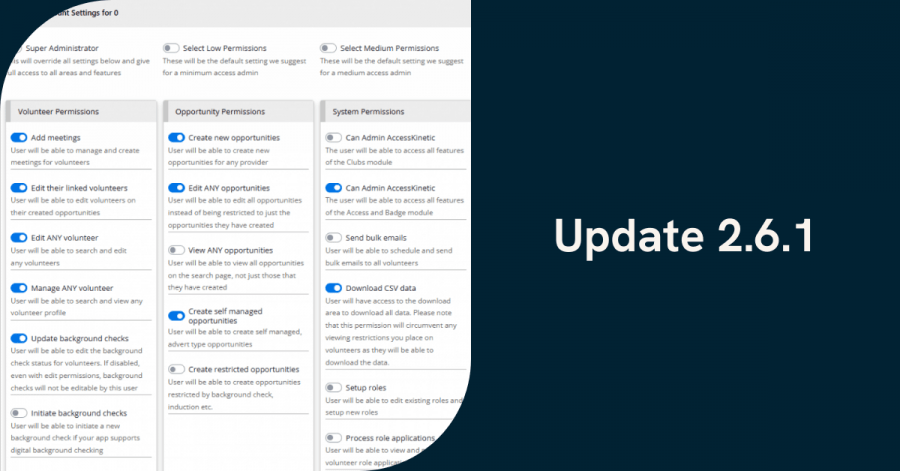
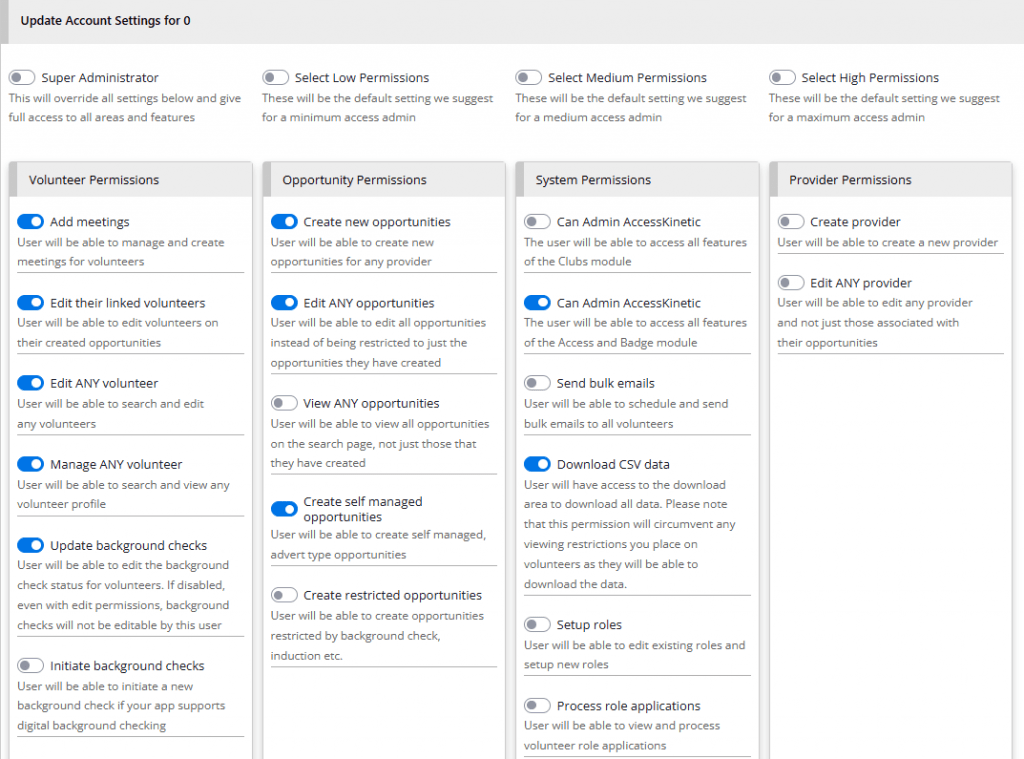
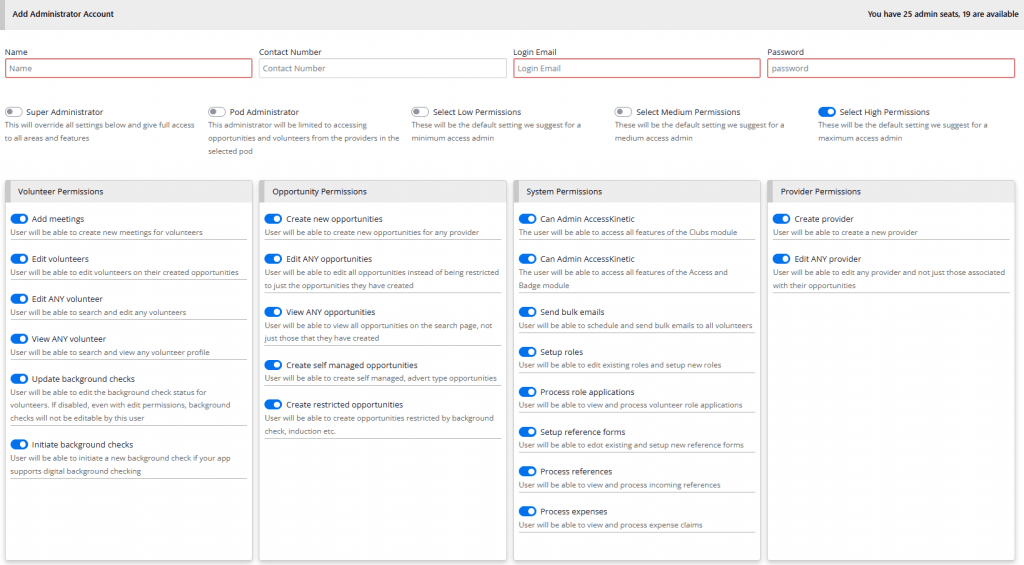
Super admins can now select granular permissions for all your administrators. Permissions are split over the four areas of volunteers, opportunities, providers and system. Each administrator can have their own bespoke permissions set. There is also a handy set of presets for low, medium, and high-level permissions.
All your current administrators will have all permissions enabled EXCEPT the system permissions, and should experience very little difference to their current mode of operation.
POD administrators will still behave as before, but their limited access to opportunities and volunteers within their pod can be overwritten by the edit all opportunities and volunteer permissions. Any existing POD admins will have those permissions disabled so that the existing POD rules are still enforced.
Of particular note are the new system permissions that allow selected administrators to edit role and reference definitions as well as process role applications and submitted references. This is the first time that Super Admins can assign some roles that were previously Super Admin-only to general administrators.
The opportunity assignment options, as detailed in the next section, can be used to define which opportunities can be accessed by administrators without the edit all opportunities permission. In these cases, any opportunity that is created by an administrator or has been assigned to an administrator is viewable and editable by the administrator.
You can refine and update all your administrators from the Super Admin Menu > Admin Accounts.
Super administrators can now assign individual administrators to particular opportunities. This has two effects.
Firstly, it enables the administrator edit access to the opportunity when they don’t have the edit all opps permission enabled.
Secondly, all enabled administrator email communications will be directed to both the assigned user and the regular central app email.
Administrators and providers can also assign a provider user to the opportunity, which affords no extra access but direct email notifications to the selected user in addition to the central provider email address.
Finally, you will notice that there is a nominal contact email box available to providers and administrators. Here, you can add any email address which will also be added to the email communications for this opportunity.
This has the advantage of not being connected to an existing user, so you could use mailing lists or group emails. Please take care not to use unauthorised emails that could enable some leaking of details to non-authorised contacts.
This nominal email feature can be optionally disabled to prevent the risk of data leakage.
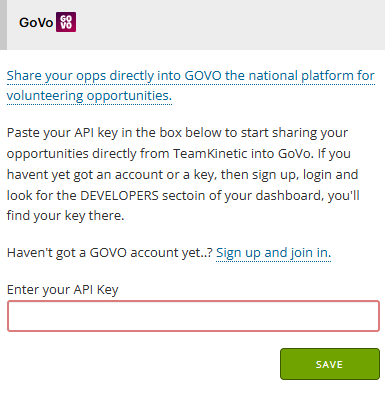
This is great news as the GOVO platform is gearing up and people are starting to talk about it.
Available from your super admin menu > setup > integrations page you simply have to add your API key to start sharing your opportunities directly to your account at GOVO.
You can either choose to share when adding an opportunity or when editing an existing opportunity. GOVO supports remote/at home opportunities, flexible and sessional and any interested volunteers that find you on GOVO will be redirected back to apply on your TeamKinetic platform. Exciting times.
Tickets For Good – Another great way to reward your volunteers
We’ve teamed up with tickets for good to enable your volunteers that have logged hours to get their hands on free or heavily discounted tickets to a huge selection of top events. There is always a small booking/ticketing fee to pay and all tickets are on a first come first served basis.
We have to pre-authorise your organisation to make sure it meets the criteria Tickets for Good set out. If you are interested pop along to the super admin menu > setup > integrations to start the ball rolling.
New status options
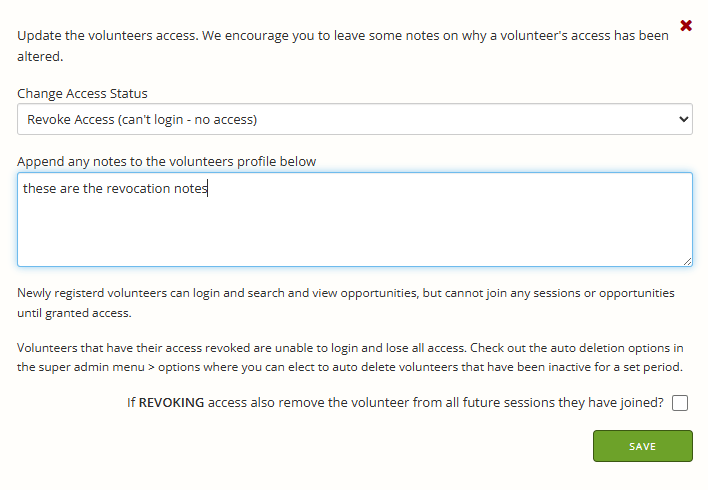
As part of the revocation options, you can now elect to remove a volunteer’s future sessions when revoking access. This means that their names will no longer show up on opportunities for future sessions, so they should not be expected or allowed to participate.
New Font – What do you think
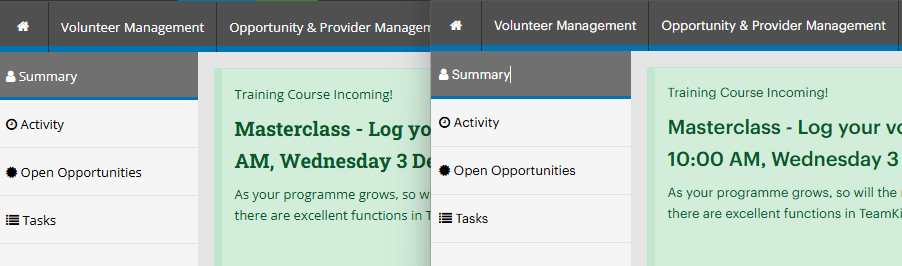
We have updated the admin system header and body fonts, we think the titles are more readable now. Hope you like it.
Did you know you can use the CSS editor in your super admin setup area to set your own custom fonts for your volunteer pages..? Open a ticket if you want to know how.
New search filters
It’s always difficult to filter out who is active, inactive, available etc, not least because what those words mean is not standardised and they can mean different things in different contexts.
In terms of reporting and hours the TeamKinetic definition of active is always on a session OR logged hours between the filter dates. However when referring to volunteer auto deletion active also includes a login event; a volunteer that has joined no opportunities but has logged in, will not be auto deleted as they are considered active.
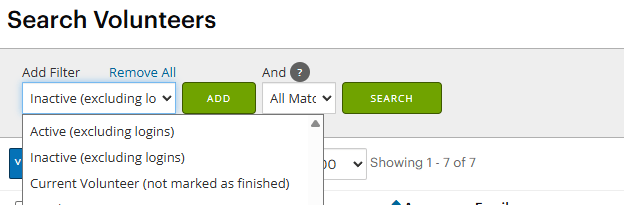
To help, we have added some new filters to handle these different situations.
The filters have some extra text so you know exactly what the filter includes and we’ve added a new filter that will pull up all volunteers that were on any opportunity in the period selected where they were not marked as finished.
Changes to log all hours page
The log all hours page has had some changes after talking with out Wildlife Trust customers who had some good ideas to make it more useful.
We have added a provider filter so you can look for specific provider’s outstanding hours, adding some more details on what the rules are when bulk logging hours.
A little checkbox to filter in/out those sessions where some, but not all, the available hours have been logged by a provider/administrator. Usually if less than the maximum hours have been logged, it’s for a reason and you don’t want that to be overwritten by the maximum.
A total can now be found at the bottom of the results and we have excluded the flexible max hours number as it was confusing and doesn’t add anything as when bulk logging flexible hours it copies the volunteer log history if it has more hours than the provider/administrator log history.
New SMS sending rules
This is actually a sort of backwards development! The rules around unsolicited text messages have been tightened up and they now prevent us from using any sender ID we wish when we send text messages. We now have to provide details on the sender ID, what it will be used for and other details, plus a regular monthly cost.
So for these reasons, we have suspended the sender ID options in the account profile area and all SMS messages are sent with a TeamKinetic sender ID. Apologies for those that have got used to having the old Sender ID flexibility.
Auto-suggest timing for typing to speed up results
You may have noticed when using the universal auto suggest search (still the best place to look for individual volunteers, providers or opportunities!) that it doesn’t attempt to search until you pause your typing. So if you type the characters S I M O N in quick succession without pausing, it will search once for ‘simon’ it wont search for ‘s’ then ‘si’ then ‘sim…..’.
This same technique has now been applied to the volunteer auto suggest searches when adding volunteers to sessions, adding meetings and everywhere else you see that volunteer search dialogue.
It reduces the time it spent searching and helps prevent timing issues with the appearance and fading of the list of auto suggested names.
In order to get the best out of the reporting and engagement data TeamKinetic can offer its important to stay on top of logging hours.
We know this can be a laborious process, so we’ve got a bunch of ways to log hours, all the way from a single button press to log everything, everywhere, to logging different hours for individual volunteers and sessions.
This masterclass will explain the difference between a volunteer and a provider/administrator logged hours, why that is important and every method of logging hours in TeamKinetic.
By the end of this Masterclass you will be confident in bulk logging and individual logging, understand the effect of bulk logging hours and what rules it follows and the importance of trying to accurately log flexible hours.
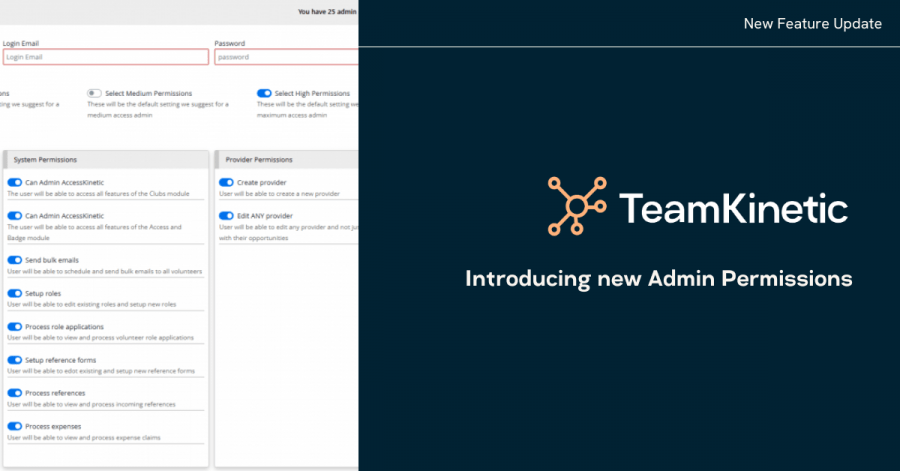
We know we have been talking about this new feature for many months but now we are thrilled to share a sneak peek at one of the most requested updates we’ve built: Granular Admin Permissions.
Managing your volunteers, opportunities, and providers is about to become more powerful and flexible than ever. Our new permissions system gives you total control over who can do what within your TeamKinetic platform – from creating opportunities and editing volunteers, to managing providers, background checks, and system settings.
You’ll be able to: ✅ Assign tailored access levels to match every role in your organisation ✅ Mix and match permissions to suit your workflows for every user ✅ Confidently delegate tasks without compromising data security ✅ Scale your admin team with precision and peace of mind
This update marks a huge step forward in making TeamKinetic even more adaptable for organisations of all shapes and sizes. Whether you’re a national network or a local volunteer hub, you’ll soon have the tools to customise admin access with unprecedented detail.
Take a look at this clip from our conference where we introduce this feature, along with Flows:
We’re putting the finishing touches on this release and we can’t wait for you to try it out.
Stay tuned for the full rollout announcement, feature deep dive, and training resources soon.
We’ve been working hard to get some of the new developments and features of TeamKinetic 2.6 released in June 2025 up and running on the native mobile apps, along with all the normal small fixes and improvements.
HTML Opportunity Descriptions
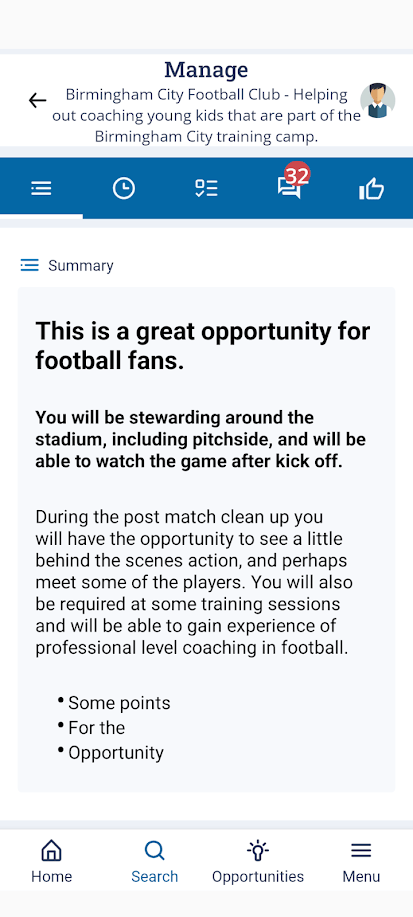
All your carefully crafted and fancy HTML powered opportunity descriptions will now be displayed on the mobile apps, both when viewed on the search view and the opportunity details view.
The same is true for the Events view now which will render the event descriptions as HTML as intended.
Resource Area and Folders
We were not able to get the resource folders into this release but we have started ordering the resources by their folder so they will be grouped by their folder.
Correct Date Format
The dates for birthdays etc are now in the correct format for the locale specified by the users device, which for most of our users will be dd/mm/yyyy.
Inbox Area
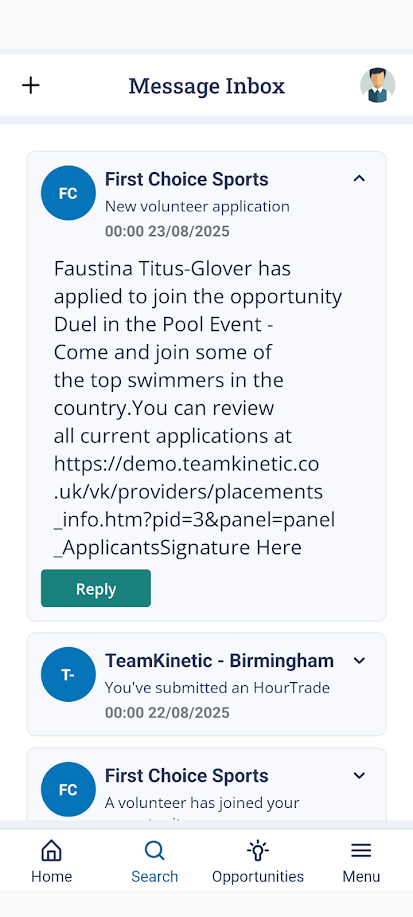
The inbox area has a number of improvements;
When replying to messages the form will reset between messages so you won’t get the old reply on the new form
The font and sizing when viewing long messages has been improved
The reply form section is now correctly shown as a multi line text area and not a single line.
The labels for the reply fields have been corrected and improved
The inbox would previously freeze and not allow you to move to a different section in the dashboard
Search Page
The strange focus effects where the cursor would jump from the location to the search text box before you could finish has been fixed.
The search results are now properly paged and you when you scroll to the bottom of the current page more results will automatically be fetched.
Finally the regional restrictions for the location search when entering a location have been fixed so it will now default to the home region of the organisation, usually the UK.
Dashboard View
As mentioned we now have HTML formatted descriptions on this view and all sections will refresh when pulling down, including the latest/new opportunities section
Opportunity View
Sessions now always use the correct start time for the session and not the start time of the opportunity wherever you view sessions.
The location details of an opportunity have been moved so they are visually associated with the map view. Additionally the location notes for area opportunities are shown.
The map and location details are also now always visible when viewing an opportunity you have already joined.
Visible Menu Entries
The menu entries for disabled features like the chat rooms, HourTrades etc are now correctly toggled off and on to match your super admin options.
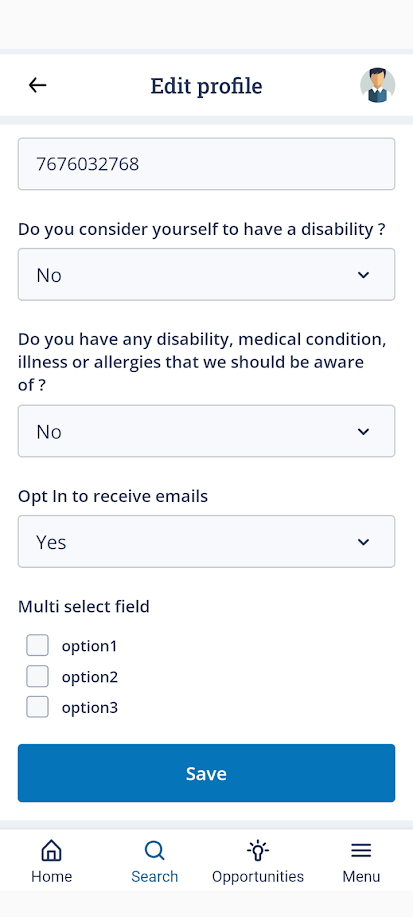
Custom Fields
All custom field types will now render correctly; this includes
Yes, No fields now show Yes and No and not 1 and 0
Multi select fields are now fully supported
We are still working on the file upload and text only custom fields ready for the next release.
There are also 35 small individual fixes and enhancements throughout the app. Your volunteers will see a notification when opening the last app that there is an update and they can install right from the notification.
We are pleased to announce that the next major update of our native TeamKinetic mobile apps is ready for launch. We’ve brought the parity between the desktop and mobile versions closer and fixed bugs and made usability improvements.
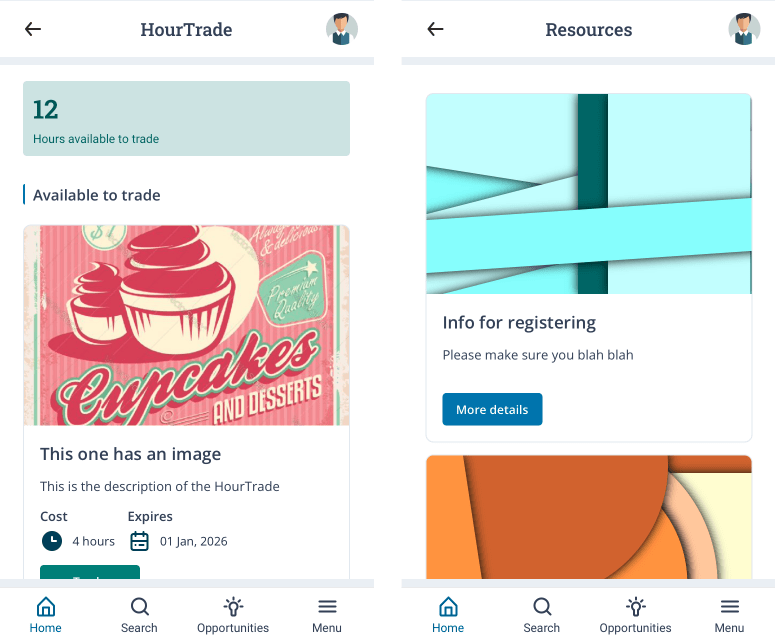
HourTrades
You can now view and process HourTrades on the mobile app, all the same functionality that is available on the desktop app is now here as well.
Resource Area
Volunteers can now access the same resources as when using the desktop app right from their dashboard in the mobile app.
Supports all the various types of resource options; links, text, downloads etc.
Opportunity Badges
We now display the opportunity badges as tags in the search results page. When viewing the opportunity, you can see the icons and names of the badges associated with the opportunity.
HTML Opportunity Descriptions and Event Description
The mobile app will now correctly display the new HTML content that we have added to your opportunity description text. You can now add links and styling to your descriptions and see them all on the mobile app.
Additionally, we have added support for HTML in the event page, which has been available in the desktop version for a while now.
Session Descriptions
The new session info descriptions that you can add to individual sessions are also supported in this new mobile release. You can add unique text and links to each individual session.
Paged Search Results
When you perform an opportunity search, you’ll get the first 25 results immediately, and then as you scroll down, we’ll present the next set to you.
This greatly improves the speed at which we can return the first set of results and provides a super easy way to get to the next set; just pull down on the screen to reveal the next 25 results.
Opportunity Chat Room Visibility
When the opportunity chat room functionality was switched off, the icon for the chat room was still shown, although the chat room was not functional. This obviously caused confusion and has now been fixed.
There are over 35 smaller updates and changes, from fixing typos to making the ordering of sessions make more sense. Update and give it a whirl.
You can find TeamKinetic on social media and listen to our podcast:
We have now completed our integration of the First Advantage suite of digital ID and background checks. You can now initiate an entirely digital ID and subsequent background check with a single button press! The results and updates are fed directly back into your TeamKinetic dashboard.
How does it work?
There is some necessary paperwork to set up your First Advantage account and create the required roles you will be using. This is where you decide if you need to check the adult or child lists and what level of checks you’ll be using. We will guide you through this process and get your account set up quickly and easily.
After that it is just a case of pre-paying for bundles of checks, switching on the option and selecting the volunteers you want to check.
Once initiated the volunteer will receive an email and a text message with the instructions and help they need.
You will be alerted as the checks progress and once complete, the background check details, dates and numbers will be recorded in the volunteer profile.
What does it cost
We sell pre-paid bundles of credits for digital ID and enhanced-level background checks. The digital ID check costs one credit and the background check a further credit. If the digital ID check fails you will only be charged a single credit, you are only charged the further credit if the check progresses to the background check stage.
Credits are available in bundles of 10 for £80.00 or 50 for £230.00 (plus VAT) and you can purchase credits directly from the app via card or bank transfer.
Where can I find out more?
We have a few videos and documents where you can discover the process and how it works.
You can also find this information in the Super Admin > Setup menu under the API and Integrations section.
Interested in taking the next steps towards fully digital and integrated ID and background checks? Open a support ticket or hit the button in the Super Admin > Setup menu under the API and Integrations section.
It’s a great way to streamline and speed up your onboarding process.
You can find TeamKinetic on social media and listen to our podcast:
Google Analytics is a service that allows you to track and report on your website traffic. By linking your TeamKinetic system to Google Analytics, you can gain a deeper understanding of your audience and how they interact with your content.
So how do you link TeamKinetic to Google Analytics?
We’ve created this handy guide on how to link your TK site to Google Analytics. The key steps:
Create a Google Analytics account (if you don’t have one already)
Set up a new property
Add your website (data stream)
Grab the tracking code
Open a support ticket with the code and we’ll do the rest!
Once you’re all set up, there are a load of things you may want to start tracking. We’ve outlined some key metrics to track.
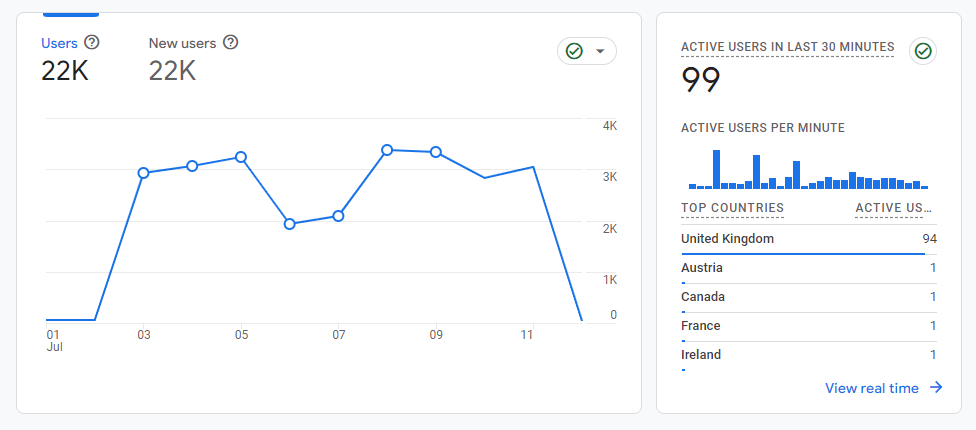
Site Visitors
Site visitors, or users, are the individuals who visit your website. Monitoring the number of visitors helps you understand the reach of your site and track growth over time.
Where to Find It
In your GA4 dashboard, go to the Reports → Life cycle → Acquisition → Overview. Here, you can view metrics such as the total number of users, new users, and active number of users in the past 30 minutes.
Why It’s Important
Knowing how many people visit your site can help you gauge the effectiveness of your outreach efforts and identify trends in your traffic.
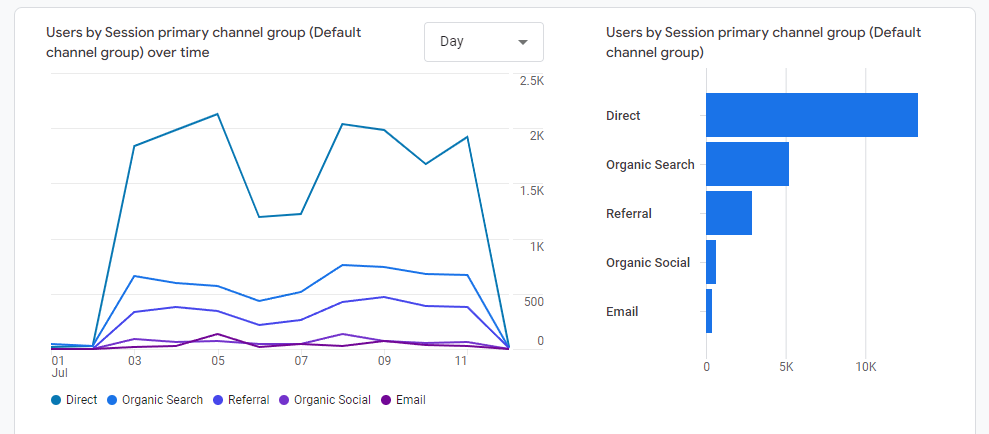
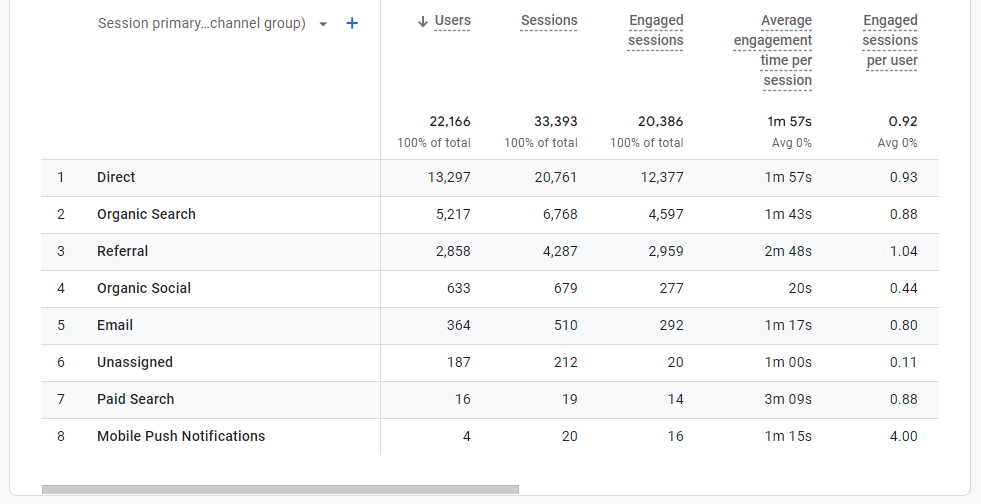
Traffic Sources
Traffic sources tell you where your visitors are coming from. This could be through search engines, direct visits, social media, or referral links from other websites.
Where to Find It
Navigate to the Reports → Life cycle → Acquisition → Traffic Acquisition. Here, you’ll see a breakdown of traffic sources, including organic search, direct, social, and referral.
Why It’s Important
Understanding where your traffic comes from helps you identify which channels are most effective in driving visitors to your site. This can inform your marketing strategies and help you allocate resources more effectively.
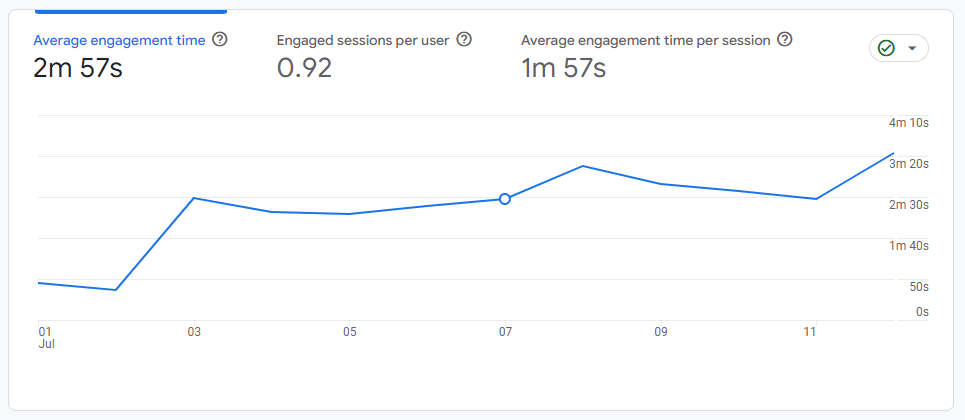
Engagement Rates
Engagement rates provide insights into how users interact with your site. Key engagement metrics include bounce rate, average session duration, and pages per session.
Where to Find It
In the Reports → Life cycle → Engagement → Overview. Look at metrics like the engagement rate, average engagement time per session, and the number of engaged sessions per user.
Why It’s Important
High engagement rates indicate that visitors find your content valuable and are spending more time on your site. This can lead to increased volunteer sign-ups and better retention.
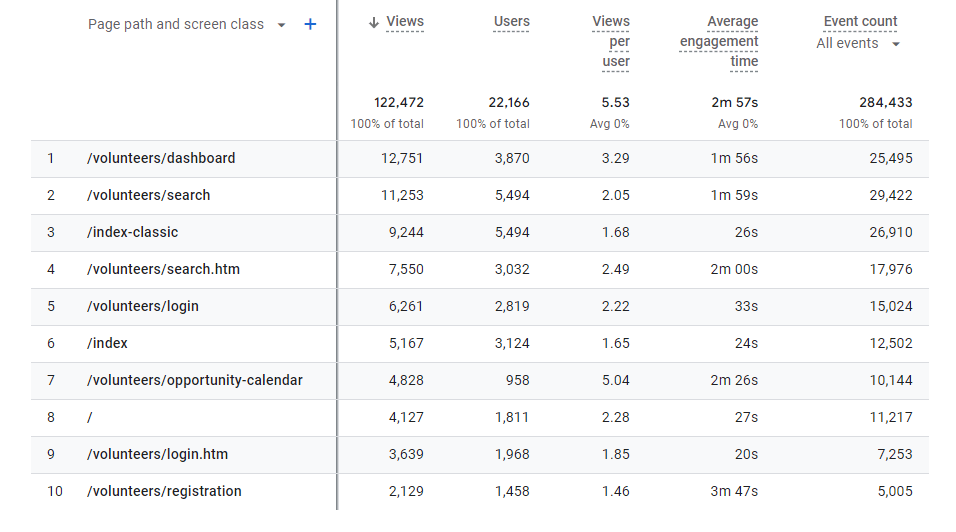
You can even see which pages are most popular on your site by going to Reports → Life cycle → Engagement → Pages and screens
Go forth and track!
By tracking these key metrics in Google Analytics, you can gain valuable insights into your website’s performance and make data-driven decisions to enhance your volunteer management efforts.
We hope this guide helps you get started with Google Analytics and empowers you to take your volunteer management programme to the next level.
You can find TeamKinetic on social media and listen to our podcast: