
Author: Alex Evans Page 1 of 25

TeamTalk June 2026

Hello and welcome to TeamKinetic’s monthly Newsletter. In between keeping tabs on local elections and enjoying the end of the football season, we’ve still been busy at work on the system and in the wider sector. Not to mention… Happy Volunteers Week! We hope you’re recognising all your lovely volunteers this week!

This roundup is designed to keep you up-to-date with what’s going on at TeamKinetic, our partners, and across the third sector in general. So grab a brew and tuck into all the latest news.

We hope you find value in this TeamTalk. As always, we really appreciate feedback, so feel free to leave a comment, shoot over an email, or message via social media.

If you’d like to subscribe to the TeamTalk newsletter, please send an email over to me at alex@teamkinetic.co.uk, and we’ll get you on the list!

To read our roundup of stories we think you need to know about, click to go to the next page below, or choose a story from the list:

Moving Beyond a Transactional Relationship with Volunteers

In the world of volunteer management, saying “thank you” is more than just good manners; it is a fundamental strategic tool. Research shows that while volunteers are rooted in altruism, they have a deeply human need to feel seen and valued. In fact, the absence of recognition is often more noticeable than its presence; volunteers may not seek constant praise, but they certainly notice when their efforts are taken for granted.

Effective recognition is the “social currency” that fuels a healthy volunteer programme. By acknowledging a volunteer’s time and emotional labour, you move from a transactional relationship to a psychological contract based on mutual respect and shared purpose.

Crafting the Perfect Message: The “Ice Cream Sundae” Approach

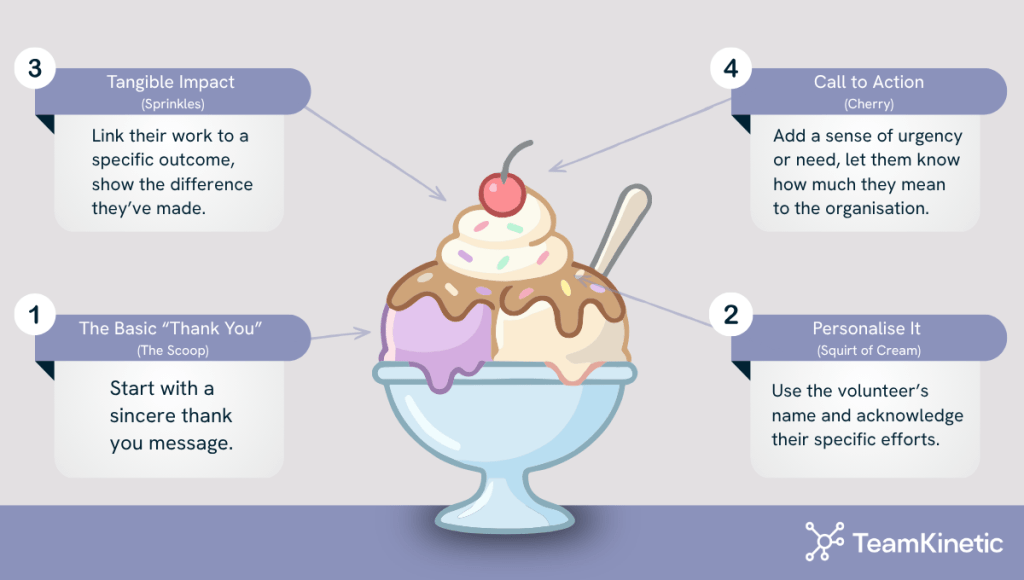
To move beyond “cookie-cutter” feedback, we recommend thinking of your feedback structure like an ice cream sundae.

…We promise it makes sense:

  • The Scoop of Ice Cream – The Basic Thank You
    Start with a sincere “Thank you”.
  • A Squirt of Cream – Personalise It
    Use the volunteer’s name and acknowledge their specific effort. For example: “Marjorie, you were absolutely great today”.
  • Some Sprinkles – Tangible Impact
    Link their work to a specific outcome. Instead of a general “thanks for your help,” try: “You made such a difference to the Rivers Cleanup Team today by clearing that difficult stretch of the bank”.
  • The Cherry on Top – The Call to Action with Scarcity
    Make them feel indispensable. Add a sense of urgency or need: “Without you, we can’t achieve this. We really want you back with us next Tuesday”.

The Science of Recognition: Nudge Theory and Behavioural Economics

Why does this specific wording work? It leverages powerful principles from nudge theory and behavioural economics:

Dopamine Hits

Recognition triggers a dopamine release in the brain, creating a positive feedback loop that makes the volunteer want to repeat the behaviour.

Loss Aversion

By wording your message to say, “Without you, we can’t do this,” you tap into loss aversion (the psychological principle that people feel the pain of a loss more than the joy of a gain). If they don’t return, they aren’t just “not volunteering”; they are “losing” the chance to make a unique impact that only they can provide.

Reciprocity

When a manager provides immediate, high-quality recognition, it triggers the rule of reciprocity, making the volunteer more likely to want to give back by returning for another session.

Feedback Loops

The TeamKinetic Thumbs UP feature provides immediate recognition, which is far more effective at reinforcing behaviour than a distant annual awards ceremony. This “micro-recognition” builds daily morale and fosters a pervasive culture of appreciation.

Why Low-Level Recognition Matters

Investing in regular, low-level recognition, like a quick thumbs up, is a strategic investment in sustainability. Evidence from NCVO’s Time Well Spent research indicates a direct link between feeling recognised and being satisfied. Satisfaction is the primary driver of retention; while 90% of very satisfied volunteers say they are likely to continue, that number drops to just 26% for those who are dissatisfied.

For younger volunteers (aged 18-34), recognition is even more critical, yet they often report feeling the least recognised. By using digital tools to provide frequent, impact-led feedback, you can bridge this gap and build a stronger, more committed volunteer community.


Find TeamKinetic elsewhere:

Volunteers’ Week: Why “Thank You” Matters More Than You Think

Guest blog for Volunteers’ Week, written by Ruth Buchanan Leonard

Every year, Volunteers’ Week invites us to pause — to look up from the processes of delivery management and remember that volunteering is, at its heart, a human act. And that gift of humanity deserves to be acknowledged.

But thanking volunteers shouldn’t be a ritual we perform once a year. It’s in the ongoing practice of noticing and showing appreciation. A way of tending to the relationships that make volunteer involvement possible.

And like all relational work, it’s more complex — and more powerful — than it first appears.

As I’ve written elsewhere: “Everyone likes to be appreciated and recognised for what they’ve done. This doesn’t mean that people are consciously looking for thanks; rather, that it becomes noticed if it’s never given.” That, to me, is the essence of meaningful recognition. Volunteers don’t volunteer for thanks — but they do leave when they don’t feel seen.

It’s tempting to think that the more extravagant the reward, the more appreciated volunteers will feel. But research — and experience — tell us the opposite. Too much or too big a reward can make people uncomfortable, or even create competition where none is needed. And of course, when we’re thinking about how to show our thanks, we need to be aware of Inland Revenue implications: giving cash (other than for out-of-pocket expenses), vouchers or setting up the expectation of regular gifts can blur the legal boundary between volunteer and employee. So it’s worth considering how you want to show your appreciation without putting volunteers or organisations at risk.

A thank you is relational. A reward can be transactional. Volunteers give their time because what they do matters. When we respond on set occasions or with grand gestures, we risk changing the meaning of their contribution. It could imply that volunteering is being “paid”, just in a different currency.

What volunteers want is to know that what they did made a difference. Sometimes the most powerful thank you is a quiet word when they’ve finished their shift, a handwritten note, or a moment of eye contact that says, “I saw that, and it mattered.” Opportunities to be heard and be involved in building the future are also valuable ways of showing people they are recognised as being important. Small, regular appreciation builds trust and belonging far more effectively than any annual celebration – important and fun as these may be.

And recognition is never a one-size-fits-all approach. As well as individual differences, there may be expectations of what feels like recognition based on age or background. I had a recent conversation with a younger volunteer about how students love a tote bag, for example. Some people love a public thank you; others would rather the floor open up beneath them than be singled out. Your role is not to assume how people want to be thanked, but to notice, to ask, and to be ready to adapt your plans.

Volunteers stay where they feel welcomed, supported and appreciated. They leave when they feel invisible. Silence and not having contribution noticed, more than anything, turns people away.

So, this Volunteers’ Week, say thank you and celebrate what volunteering brings. Say it often. Say it genuinely. Say it in ways that respect the volunteer’s agency – and plan how to make this ‘thanks’ habitual. Because volunteering practice is built on relationships, reflection and responsiveness. Recognition is one of the simplest—and most powerful—ways to live those values.

If you want to reflect more on ways to thank volunteers and volunteer involvement more widely, this upcoming coaching programme from our friend Tobi Johnson may help. Learn more here: https://volpro.mykajabi.com/a/2148280246/zNVTAr8m 

As a special offer for TeamKinetic members, use code RUTH to get 15% off.

I’ll be offering complementary drop-in webinars throughout the course, so email me at ruth@teamkinetic.co.uk if you want to be involved. 

How you can Reward your Volunteers with Virtual Badges

Volunteers’ Week is just around the corner! With that in mind, how do you currently recognise your volunteers’ contributions? If you’re looking to improve your volunteer engagement, TeamKinetic’s versatile badge system is a great way to reward and recognise volunteers, validate their training and skills and guide them towards the most suitable roles. 

Badges and reward pathways introduce gamification to volunteering, making it a driving force in volunteer retention. Using automated reward pathways ensures that no milestone is missed and volunteers are recognised at each stage of their journey. 

Different Badges in TeamKinetic:

Achievement Badges 

These badges provide a linear reward pathway, allowing the volunteer dashboard to become a Trophy Case.

Once a badge is earned, it’s featured prominently on the volunteers’ dashboard and is downloadable via their achievement record, which they can take onto future opportunities.

Customisation is the key here! Whilst TeamKinetic provides a default set of badges, you can redesign these badges, change their name and alter the hour count required to achieve each level.

Introducing a VMS shouldn’t mean a personal touch is lost, and badges are a great way to add your own flair.

If you’re stuck for ideas, think of any emblems associated with your organisation and incorporate them into the design!

Award Badges

Custom Award Badges allow you to get really creative with how you recognise volunteers.

Here you can design and upload Open Badges to record details around skills and achievements. Or you can upload your own designs to recognise Long Service, Volunteer of the month or other awards specific to your organisation.

Similar to Achievement Badges, Award Badges also appear on the volunteers’ dashboard and form part of their achievement record.

As part of the celebrations, we’ve created this custom TeamKinetic 2026 Volunteers’ Week Recognition Badge that anyone can use to recognise their volunteers between the 1st and 7th June.

Creating a custom badge like this from your organisation is a super simple way to show your volunteers that they’re appreciated.

Opportunity Badges: 

Badges are not only given to people; they are also used as fully customisable visual indicators attached to specific volunteering roles.

Administrators can tag opportunities with badges such as “Great for Corporate Teams”, “Micro Volunteering”, or “Suitable for Duke of Edinburgh Awards.” These visual cues allow volunteers to search for opportunities more fluidly and select their preferences more easily.

The TeamKinetic badge system helps you reward every effort, from major milestones to micro-volunteering tasks.

We challenge you to get inventive with your badge designs and reward pathways for Volunteers Week. The more personal and specific the recognition, the more valued your volunteers will feel!


Learn more about Reward and Recognition

On Wednesday 3rd June, Steve will be leading a Masterclass on volunteer reward and recognition within TeamKinetic. We’ll be showing you all the top tips to get you into the swing of things with Volunteers’ Week!

TeamKinetic users can book now for free via their system: Help & Support → Masterclasses & Training.

Digital in Volunteering Community of Practice

The CoP also has a lot of great resources for volunteer managers looking for tips on reward and recognition. A webinar back in September 2025 took a deep dive into all about the different ways you can say thank you to your volunteers. We heard from speakers from Volunteer Glasgow, Tempo, and Tickets for Good. You can read all about this session and watch the recording back here (membership is completely free).

The Digital in Volunteering Toolkit also contains a whole chapter about reward and recognition, which you can also access here.

Access Resources for Volunteers Week

The official Volunteers Week website has an array of great resources. Including materials for engaging with the campaign online, hosting events (both virtual and in person), top tips, and much more. Access these here.

The Volunteers’ Week Padlet

They’ve created a Padlet – a collaborative online pinboard where you can share and explore inspiring stories, photos, and messages of appreciation related to volunteering.

Whether you’re highlighting your own volunteering journey or thanking someone who’s made a difference, the Padlet is the perfect space to celebrate the incredible impact volunteers make every day.

Share your experiences now. Help them build a vibrant wall of gratitude and celebration!


Find TeamKinetic on socials:

TeamTalk May 2026

Hello and welcome to TeamKinetic’s monthly Newsletter. We had a pretty busy April so we have another big dose of news from us, our partners, and the wider sector for May. Grab a brew and tuck into all the latest!

This roundup is designed to keep you up-to-date with what’s going on at TeamKinetic, our partners, and across the third sector in general.

We hope you find value in this TeamTalk. As always, we really appreciate feedback, so feel free to leave a comment, shoot over an email, or message via social media.

If you’d like to subscribe to the TeamTalk newsletter, please send an email over to me at alex@teamkinetic.co.uk, and we’ll get you on the list!

To read our roundup of stories we think you need to know about, click to go to the next page below, or choose a story from the list:

TeamKinetic is now a Proud Trusted Partner of Volunteer Scotland

We are excited to announce that TeamKinetic is now a Trusted Partner of Volunteer Scotland!

We're a trusted partner with Volunteer Scotland.

Our partnership with Volunteer Scotland has been ongoing now for a number of years, but this new status names us as a Trusted Partner and coincides with the launch of their Knowledge Gateway (more on that later!).

Volunteer Scotland serves as the national centre for volunteering in Scotland, driven by a mission to boost not only volunteering numbers, but the quality of the volunteer experience too.

We are thrilled to take this next step in our ongoing commitment to supporting the voluntary sector. We are also thrilled to be the first volunteer management provider to be named as a Trusted Partner!

The Knowledge Gateway

Volunteer Scotland have also just launched the Knowledge Gateway. This is a central hub that provides practical guidance, training, and resources to help develop, promote, and strengthen volunteering across the nation.

It’s designed to empower volunteer-involving organisations and create the conditions where volunteering can truly thrive.

“The Knowledge Gateway marks a strategic step forward for volunteering in Scotland. By bringing together high-quality guidance, training, and shared learning from Volunteer Scotland and a range of Trusted Partners and Public Information Providers we are strengthening the foundation that supports volunteers and the organisations they power.”

Rosie Wylie, Deputy CEO and Head of Innovation & Operations at Volunteer Scotland

It includes information on:

  • TSIs & Advertising Opportunities
  • Practice Guidance & Information
  • Training and Events
  • Quality Standards & Principles
  • National Employer Supported Volunteering (ESV) Framework
  • Bespoke Support and Development Service
  • Trusted Partners (like us!)

We highly encourage all volunteer managers, especially those in Scotland, to explore the Knowledge Gateway and gain access to fantastic tools, insights, and support.

Being a Trusted Partner

We are incredibly proud to have been accepted into the Trusted Partner scheme. The purpose of the scheme is to promote high-quality support, services, and expertise provided by external organisations to volunteer-involving groups through the Knowledge Gateway.

As a Trusted Partner, TeamKinetic actively supports Volunteer Scotland’s mission and aligns with their core values. Our working relationship with Volunteer Scotland also helps us understand the specific needs of our Scottish users and stay up to date on volunteering trends across the nation.

Through this partnership, Volunteer Scotland will host and maintain a dedicated space for TeamKinetic on the Knowledge Gateway. This will make it easier than ever for Scottish organisations to discover our practical tools designed to help you connect with your volunteers. Furthermore, this partnership creates new opportunities for us to offer exclusive discounts to Volunteer Scotland members and stakeholders.


Find out more about Volunteer Scotland

Connect with TeamKinetic:

TeamTalk April 2026

Hello and welcome to TeamKinetic’s monthly Newsletter. April comes with another big dose of news from us, our partners, and the wider sector. Grab a brew and tuck into all the latest.

This roundup is designed to keep you up-to-date with what’s going on at TeamKinetic, our partners, and across the third sector in general.

We hope you find value in this TeamTalk. As always, we really appreciate feedback, so feel free to leave a comment, shoot over an email, or message via social media.

If you’d like to subscribe to the TeamTalk newsletter, please send an email over to me at alex@teamkinetic.co.uk, and we’ll get you on the list!

To read our roundup of stories we think you need to know about, click to go to the next page below, or choose a story from the list:

TeamTalk March 2026

Hello and happy March! Welcome to TeamKinetic’s monthly Newsletter. We have a good dose of news for you to sink your teeth into this month, so grab a brew and tuck into all the latest.

This roundup is designed to keep you up-to-date with what’s going on at TeamKinetic, our partners, and across the third sector in general.

We hope you find value in this TeamTalk, as always, we really appreciate feedback, so feel free to leave a comment, shoot over an email, or message via social media.

If you’d like to subscribe to the TeamTalk newsletter, please send an email over to me at alex@teamkinetic.co.uk and we’ll get you on the list!

To read our roundup of stories we think you need to know about, click to go to the next page below, or choose a story from the list:

TeamTalk February 2026

Hello and happy February! Welcome to TeamKinetic’s monthly Newsletter. We hope you’re getting into the swing of 2026! I’m not sure about you, but it’s been a very busy January over here at TeamKinetic. We still have a good chunk of news for you to sink your teeth into, so grab a brew and tuck into all the latest.

This roundup is designed to keep you up-to-date with what’s going on at TeamKinetic, our partners, and across the third sector in general.

We hope you find value in this TeamTalk, as always, we really appreciate feedback, so feel free to leave a comment, shoot over an email, or message via social media.

If you’d like to subscribe to the TeamTalk newsletter, please send an email over to me at alex@teamkinetic.co.uk and we’ll get you on the list!

To read our roundup of stories we think you need to know about, click to go to the next page below, or choose a story from the list:

The Heart of Your Programme: Volunteer Reward and Recognition

We all know that a simple “thank you” goes a long way, but in the busy world we live in, it’s easy for volunteer reward and recognition to slip to the bottom of the to-do list. However, acknowledging the time, skills, and emotional energy your volunteers give is actually the backbone of a healthy and sustainable programme.

By acknowledging the time, skills, and emotional energy volunteers give, you’re doing more than just being polite; you’re making a strategic investment in your organisation’s future.

Why recognition matters more than you might think

Most people volunteer for altruistic reasons. They want to help or feel a personal connection to a cause. However, as Ruth Leonard and Jurgen Grotz note, while people aren’t usually hunting for thanks, they certainly notice if it’s never given!

‘Most of us like to be appreciated and recognised for what we’ve done. This doesn’t mean that people are consciously looking for thanks, rather that it becomes noticed if it’s never given. Probably, the most important thing that can be done in order to continue a relationship with volunteers is to make sure they know that they and what they do are valued.’

Grotz & Leonard (2022)

Focusing on appreciation isn’t just a “nice” thing to do; it makes great business sense, too. It leads to:

  • Lower Turnover: Volunteers stay longer, which means you spend less time and money on constant recruitment and onboarding. NCVO’s Time Well Spent research found that 81% of satisfied volunteers plan to continue over the next year, compared to just 26% of dissatisfied ones.
  • A Supportive Community: When you recognise volunteers, they start to recognise each other, creating a friendly, reciprocal environment.
  • Better Results: High engagement usually leads to better outcomes for the people or communities you serve.
  • Attract Younger Talent: Recognition is especially important to younger volunteers. While 40% of all volunteers value it, that number jumps to 49% for those aged 18–24.

Simple Ways to Say Thanks

You don’t need a massive budget to make someone feel valued. In fact, research shows that the most popular form of recognition is just a verbal or written thank you.

  • Personalised Notes: A quick email or a handwritten letter can mean the world.
  • Validation from the Top: Having a thank-you note come from a senior leader or the head of your organisation can make a volunteer feel their work is being noticed by the whole charity, not just their immediate supervisor.
  • Tangible Proof: Certificates remain a classic and effective way to celebrate a job well done.

Keeping it Legal: The Tax Bit

Before you start handing out gifts, it’s important to keep HMRC in mind. To avoid accidentally creating an employment relationship, rewards should be occasional, low-value, and unexpected.

An image showing a green box with what are considered safe bets. These include: Reimbursing out-of-pocket expenses (always keep receipts!), small tokens like a mug or flowers, and training that is directly related to their role.

It also has a red box with things to avoid. Including: Regular cash payments, high-value vouchers, or promises of future paid work, as these can trigger tax liabilities and employment rights.

Making it Easier with TeamKinetic

If you use the TeamKinetic system, there are some built-in tools that can help you automate these “thank yous” so they don’t get forgotten. If you use other tools, you can still use these ideas as a blueprint for your own recognition strategy.

The “Ice Cream Sundae” of Feedback

We love this metaphor for giving great feedback. Rather than a “cookie-cutter” message, try layering your appreciation like a sundae:

  • The First Scoop: The base—a simple “thank you” for their time.
  • The Sprinkles: A personal detail about something they did well (e.g., “You were so helpful with the registration desk today!”).
  • The Cherry on Top: A warm invitation to come back again soon.

Milestone Badges (Gamification)

You can create Custom Award Badges for anything you like—from “Volunteer of the Month” to “Length of Service” milestones. Some organisations get creative, using nature-themed badges where a new volunteer starts as a “Seed” and grows into a “Veteran Tree” over time. These digital badges appear on the volunteer’s profile as a permanent record of what they’ve achieved.

HourTrades: Exchanging Time for Perks

HourTrades allow volunteers to “swap” the hours they’ve logged for small rewards.

  • What to offer: This could be some branded kit, like t-shirts or mugs, or even better, training opportunities like a first aid course or a coaching qualification.
  • How it works: You set the “price” (e.g. 10 hours for a t-shirt), and the system handles the request for you.

High-Value Perks at No Cost

Through our integrations, you can offer some pretty cool perks without spending a penny of your own budget:

  • Tickets for Good
    Gives volunteers who have logged a set amount of hours access to free/discounted tickets for live music, comedy, and sports events.
  • Tempo Time Credits
    A national scheme where volunteers earn credits in exchange for volunteering hours. They can then spend credits on various experiences.

Are you a visual learner?

In this recent TeamKinetic masterclass, Rolf went through some of the most effective way to thank you volunteers. He shows you how to use TeamKinetic to effectively reward and recognise your volunteers.

Final Thoughts

At the end of the day, you don’t need any fancy methods of reward and recognition. You just need to be consistent and sincere. Whether you’re sending quick feedback after they’ve completed an opportunity or setting up a badge system for long-term achievements, the goal is to make sure your volunteers know that what they do truly matters.

You can access a full training guide for reward and recognition here.

If you’re a TeamKinetic user, why not jump into your super admin menu today and try creating your own Achievement Badges or add some HourTrade vouchers? If you aren’t using the system yet, why not contact us to see how we can help you.

What’s next?

Next up in our Masterclass series, we’re joined by Tobi Johnson. Tobi is an expert in all things volunteer management and has been sharing her wisdom via VolunteerPro since 2015. She’s joining us to discuss how to re-engage lost volunteers. Or, in her words, “How to Plan a Wildly Successful Volunteer “Win-Back” Campaign”!

TeamKinetic users can book now via their system (Help & Support → Masterclasses & Training), everyone else can use this Eventbrite page to reserve their place. We think this will be a popular one so get tickets while you can!

Page 1 of 25

Powered by WordPress & Theme by Anders Norén