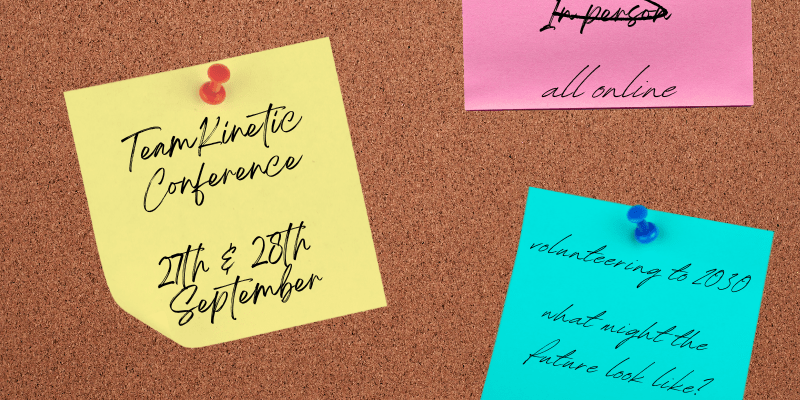
The TeamKinetic conference is back! This year we’re bringing you a range of exciting speakers from across the third sector, all tying into our main conference theme:
‘Volunteering to 2030: What might the future look like?’
The conference will be split over two days, with day one focusing on TeamKinetic itself and day two taking a look into the third sector as a whole.
Dates: Tuesday 27th September – Wednesday 28th September 2022
Note: TeamKinetic admins should have received an email about special rate tickets.
You can also join our Facebook event page to read up on all the speakers and join the discussion before the conference begins! Just follow this link.
Day One
Features a range of sessions hosted by Chris, Steve, and Rolf on the TeamKinetic system as it stands today and how it could change in the future. Keep your eye out for one or two new features!
Day One is catered specifically towards existing TeamKinetic users, but all are welcome to join!
Day Two
Featuring a keynote from Rob Jackson, day two takes a look at the third sector as a whole. Our speakers look into best volunteer management practices, their recent work, and how managers may need to adapt for the future. We currently have confirmed speaker sessions from Sport England, vHelp, Tempo Time Credits, and more!
Studying Business Studies and Graphic communications at A-Level sparked my interest in marketing, I enjoyed both aspects of the subjects which then triggered my initial passion for marketing as I believed it was the perfect combination of the two. I thought marketing was the best-suited course for me to study at university and after just completing my second year at Manchester Metropolitan University I can confidently say it was the right choice. The course has included many modules, however, a favourite of mine included digital marketing as I loved getting stuck into creating mockup social media content on Canva for different brands.
This particular module inspired me to create content for smaller businesses. In my home town, I knew of several small businesses that had been started in lockdown from home. I got in contact with some and asked if I could design material for them. This then led me to produce logos, digital menus, giveaway posts and more for a takeaway food business and an eyelash technician business. This experience allowed me to fall in love with producing marketing content and allowed me to explore my creativity skills.
Marketing material for small business
Volunteering Experience
I completed my first volunteering role during my bronze Duke of Edinburgh. For 6 months I helped out in a care home by serving food and drinks to the residents and cleaning around the home. I enjoyed listening to all the interesting stories the elderly had from different moments in their lives. Although my short volunteering experience mostly involved pouring tea, I did find my time overall there to be very rewarding. I felt valued by the residents and it was inspiring to see all the volunteers who had taken time out of their lives to help others.
Knowing TeamKinetic can make other volunteers feel just as motivated as I did, made this particular placement role stand out to me. TeamKinetic can help volunteers to find opportunities which can benefit them and enable them to have a rewarding feeling and sense of achievement.
Hobbies
During the summer of 2021 I had a lot of spare time before starting my second year of university so I decided to create my own Jewellery. It started off as a hobby for myself as a bit of fun but then I got creative with it and produced some images of the pieces I had made. Once university started again in September I found myself busy with other activities which didn’t leave much time for me to continue making pieces. However, I do try to make time to design some Jewellery every so often as it’s very therapeutic and allows me to use my creative flair.
Image of handmade Jewellery
In The Future
I am looking forward to completing a year in industry working at TeamKinetic which will help me get the most out of my marketing course. On-the-job training that TeamKinetic offer will also provide me with new skills and gain confidence in areas I am not yet familiar with. TeamKinetic are a motivated team which I am excited to be a part of as they help make life easier for people who want to do good in the volunteering community.
Managing event volunteers is no easy task, but they’re an essential piece of the puzzle that is creating a successful event. It helps that nowadays, we have a range of digital solutions that can speed up processes and cut down on stress.
With the UEFA Women’s EURO 2022 coming up – less than a month away – we’d like to take a look into large-scale events and what it takes to keep them running smoothly.
EURO 2022
Yes, we are officially less than one month away from the start of the EUROs! This year it’s taking place in England – something I am personally very excited about.
I’ve seen first-hand the impact these competitions have on the local area and country as a whole. Attending the 2017 EURO in The Netherlands and 2019 World Cup in France are experiences I won’t forget in a hurry!
Aside from what happens on the pitch, it’s also clear how much hard work goes into each tournament. This year is no different. It is estimated that around 1500 event volunteers will help out across the host cities. These cities range from up north in Manchester and Sheffield, to down south in Brighton and Southampton. So how did volunteers get involved?
How are event volunteers recruited?
From recruitment to rewarding, digital makes everything easier. EURO 2022 is no different. Their entire volunteer recruitment process was online. Running from September 2021 to April 2022, prospective volunteers applied online and were then interviewed via video chat. All successful applicants could then use the official volunteering portal to find out more about their roles.
Each host city’s team of volunteers will aid the influx of football fans. This is likely to include guiding them around the city centre, stadiums, Fan Zones, and transport hubs.
Around 50% of the volunteer roles will be focused on spectator services. This includes building the crowd atmosphere, helping people find their way around the stadiums, and answering any questions visitors might have.
Getting your event volunteers ready
I think we’ve established that volunteers are vital to the smooth running of any and every event. The level of training they receive is also vital. Volunteers could be meeting people who have never visited the local area before. Seeing a friendly face is likely to make all the difference to their experience.
This is why it’s important to provide suitable training to all volunteers. While some training requires face-to-face delivery, it doesn’t mean digital can’t be involved. Being able to track whether volunteers have completed training and what steps they have to take next saves time and effort.
For instance, EURO 2022 began training their volunteers in April. Their training includes material specific to the role they signed up for as well as the stadium or host city they will be working in.
Accreditation
Alongside training, accreditation passes are another key thing to prepare. Volunteers that have completed all the necessary requirements and are authorised to be at the venue(s) will be given passes.
With TeamKinetic, you can automatically create Accreditation Badges for specific events or single opportunities. We also have a version specifically created for events – AccessKinetic.
Keeping them updated
Communication is the foundation of good volunteer management. Whether you’re building relationships with your volunteers or keeping them up-to-date on what’s going on in the run up to an event.
Nowadays, all good volunteer management systems will allow you to send emails, SMS text messages, notifications, and share to social media.
Furthermore, the ability to use chat rooms (like in TeamKinetic!) is an added bonus. WhatsApp is a popular medium for instant communications, yet it has its risks. Aside from the big issues like data protection, instant messaging services open the door for unfiltered communications and the potential sharing of misinformation.
With opportunity-specific chat rooms, volunteers can communicate with one another and the opportunity provider. This means they can post questions, build relationships with the people they’ll be working alongside, and offer their peers support. All this is possible before, during and after the event.
An example of an opportunity chat room within TeamKinetic
Rewarding all that hard work
While volunteering at such a prestigious event is a reward all on its own, the people giving their time still deserve appreciation.
For example, all EURO 2022 event volunteers will receive a uniform to keep as a momento after the tournament is over. They’ll also undoubtedly receive post-event communications thanking them for their contributions.
Providing these momentos and setting up automated communications after the event is a great way to show your appreciation and possibly convince your volunteers to apply for your future events. Other ways you can show appreciation are through paying expenses and sending them a thank you card. However, the possibilities are endless, just check out this blog on how else you can reward your volunteers.
Adopting your own system
Interested in speeding up your volunteer registrations and reducing administrative burden? Look into adopting a volunteer management system. You can start with TeamKinetic. We’d be happy to take you through a demo of our system, just reach out via the live chat on our website or email me at alex@teamkinetic.co.uk.
Today is the day! The beginning of Volunteers’ Week is here (in the UK). Are you ready to celebrate your volunteers and the impact they’ve made?
We know how important volunteers are to organisations across the UK – Volunteers’ Week is a time to show your gratitude. This year Volunteers’ Week crosses over with the #MonthofCommunity, have you thought about the ways you can incorporate your community in your celebrations?
Celebrate the achievements.
The main focus is to celebrate your volunteers and their hard work, but it can be a time to raise awareness of the benefits. This goes for those volunteering and those whose volunteering efforts have helped.
Benefits for volunteers include connecting with others, increasing a volunteer’s social skills and making new friends. Volunteering can also help a volunteer’s mind – mental health is important and becoming a volunteer can help this. For those looking to advance their career, volunteering is a brilliant way to gain develop skills to help with this.
There are a plethora of benefits to volunteering; Volunteers’ Week can show those on the fence that volunteering really is one of the most rewarding things you can do.
Celebrate your volunteers’ impact.
Show your volunteers just how much they have helped your organisation- show them the numbers (so to speak!) People are much more likely to start volunteering, or get up and volunteer again if they’re able to see first-hand the impact they can/are making.
Letting a volunteer know what they’re impact is can be the greatest way that volunteers are celebrated this week. While there are many ways you can measure the impact a volunteer has made, just by simply letting them know about the difference they’ve made can raise spirits.
We know for many organisations they rely solely on volunteers to run- without them, what are organisations supposed to do? Keeping volunteers onboard is crucial, and Volunteers’ Week can help you keep them closer than ever.
What are you waiting for?
Why don’t you combine Volunteers’ Week, the #MonthofCommunity and the Queen’s Diamond Jubilee? Celebrate all three at the Big Jubilee lunch tomorrow – a day of milestones for many. Whichever way you decide to thank your volunteers over the next week- let us know! Tweet us over at @TeamKineticUK or find us on Facebook and Instagram under the same name- we want to hear from you!
There’s just oneweek to go until Volunteers’ Week 2022! How are you planning to recognise the hard work and effort of your volunteers? We all know the value volunteers bring to organisations, but more often than not, many volunteers go unnoticed.
With Volunteers’ Week right around the corner, it couldn’t be a more appropriate time to thank your volunteers for everything they do. Struggling for ideas? We might be able to help….
Why is it important?
Spending time rewarding your volunteers throughout the year is so important for retention. Whatever their reason for volunteering, volunteers want to feel valued. For many it may be the reason why they volunteer with you… They’re given an incentive to volunteer as much as they can.
Even just a simple ‘thank you’ after an opportunity can boost a volunteer for the rest of the day. It’s that feeling of being wanted- being valued- that you can really tap into during Volunteers’ Week. Your volunteers deserve it, and not just between 1-7th of June.
Focus on the impact!
Your volunteers spend so much time helping organisations without ever realising the impact they’ve made. While they will know who they’re volunteering for and the values that each organisation has, they might not think so much about their own impact. Shouting from the rooftops the exact impact they’ve made will help them feel valued like never before.
There are a number of ways you can celebrate your volunteers during Volunteers’ Week, no matter the budget you might have. Why don’t you set up a social event? It can even be online or a hybrid event to reach as many volunteers as possible. You could highlight the work completed over the year, or even show them how their skills have helped others.
The power of social media..
Use the hashtag #VolunteersWeek and show off your volunteers’ hard work and efforts to the rest of the world – they deserve it! Your organisation may also get some organic exposure. In the weeks after Volunteers’ Week, you may have a bunch of new volunteers signing up.
Not only can you promote your volunteer efforts, you can also use social media to thank them. There’s no doubt organisations have a group chat with volunteers to keep them informed. Why not use that to your advantage. Jump into the group chat and let your volunteers know how valued they are. Start conversations with volunteers about their motivations behind volunteering and what they’re thankful for.
Social media is a strong tool that everyone uses. We’re constantly connected, for organisations with a small budget, social media may be the best tool to use this Volunteers’ Week!
Finding gifts at a low cost…
Whether your budget only covers something ‘low-cost’, or you’re just looking to try something new, there are a number of low-cost options you can go for to celebrate your volunteers…
It could be a card, or even a postcard commemorating a volunteer’s hard work and effort. We’ve found that sometimes, volunteers love a good badge. Despite the low cost, volunteers will feel appreciated and let everyone else know about the difference they make.
Even small things, such a tea bag, or a packet of coffee – so your volunteers can have a cuppa on you. It’s often the small things that volunteers appreciate the most, little can sometimes mean a lot.
We don’t normally like to toot our own horn, but over the past few years we’ve been involved in some exciting projects and we’ve won some awards too! Much like with volunteers, we have to celebrate our hard work and give ourselves a little bit of a round of applause…
iNetwork Awards
The iNetwork Awards celebrate and share innovation across the local public sector and its partner organisations.
In 2021 we won two awards:
The COVID-19 Response Recognition Award. A brand new category, which recognises the response and recovery to the unprecedented challenges brought by the COVID-19 pandemic.
The Partner Excellence Award. This celebrates innovation, collaboration, efficiency and going the extra mile in partnership working.
Both awards were won alongside Halton and St Helens Voluntary and Community Action (HSHVCA) for our combined work on their Volunteer Portal. The programme had a significant impact on supporting local residents through the pandemic. Over 32,000 people were supported by volunteers who registered on the portal to support others. The portal and the app, displayed how volunteers and community tasks can be managed more efficiently through a collaborative, digital approach.
In August 2020, NHSx (in partnership with NHS England and NHS Improvement and the Ministry of Housing Communities and Local Government) asked the Health Innovation Network (HIN) to undertake an evaluation to better understand digitally supported micro-volunteering models operating in the field of health and social care. This report presents learning from the evaluation and is aimed at an audience of commissioners and policymakers to inform their strategies around micro-volunteering.
TeamKinetic was selected to be one of the products evaluated after being commissioned through Techforce 19 in direct response to the COVID crisis. The lessons from the last 2 years as identified in this evaluation are digitally supported voluntary action that is delivered right in the heart of local communities is essential to resilience and should be considered an essential part of commissioners and policymakers thinking when looking at developing stronger neighbourhoods and communities and social care support.
TeamKinetic is proud to be part of this work. We have seen micro-volunteering as one strand in a wide range of potential interventions that broaden accessibility and inclusion in volunteering as well as the wider voluntary sector. Meanwhile, they also provide a lower-cost solution to community-based social care. Local digital solutions like ours allow local stakeholders to take direct ownership and control, empowering communities to become more resilient with much greater levels of trust and agency.
The LGC Awards exist to identify, celebrate and help spread the finest example of innovation and quality delivered by councils on a daily basis. Winning an LGC Award has become the most sought-after accolade in local government.
In 2021 we made the shortlist for two LGC Awards:
Campaign of the Year. For our #StHelensTogether community response to COVID-19 in collaboration with St Helens Borough Council.
Technology. For our work with Halton & St Helens Voluntary and Community Action (HSHVCA) on their volunteering portal at the start of the pandemic.
Kindocoin SBRI Challenge
This was a Small Business Research Initiative (SBRI) competition funded by The Can Do Fund and hosted by Health Innovation South East Scotland Innovation. HISES is the East Region Test Bed in NHS Scotland. The aim was to develop a prototype solution to increase volunteering in the community to support delayed discharges.
We were awarded a contract to work with five test beds across Scotland in 2020. Our task was to develop a feasible solution that will enable people awaiting discharge from hospital to be connected with a volunteer who, with their approval, will be available to support them in safely getting settled back in their home.
Volunteer management systems are beneficial to organisations- we think everyone knows this. But sometimes, organisations may find they’re struggling to convince others a software is what they need. And a lot of the time that’s down to cost and budget…
Leaders are likely to look straight at the price and make a decision straight away. Volunteer management software is an investment for your organisation and your leadership should understand this! Building a business case to go alongside the pricing will help massively in convincing the decision makers software is the way to go.
“Aren’t our volunteers free?”
At some point, we’ve all heard this phrase. The illusion that volunteers mean free is simply false. Putting time and effort into volunteer processes shows volunteers that you’re the real deal- that you’re investing in their benefits too. While volunteers may be helping for free, managing rotas, sessions and volunteer satisfaction comes at a cost.
Why don’t you take a look at the amount of time you’ll save once a volunteer management software has been implemented compared to the cost of said software. By knowing just how much time (and money) would be saved in the long run, you might find that your colleagues would be open to investing.
“We currently don’t have the budget for this…”
This might be disheartening, but it isn’t a straight no- it allows you the time to build up a stronger business case to come back to. Senior management may want to move forward, but just don’t have the budget at the moment. So in the meantime, strengthening your case for a VMS means it’s top of the list when there’s a budget available.
Is there anything in your current budget you could live without? If you think a volunteer management system is a high priority- is there anything lower in priorities you’re currently spending money on? It could be worth foregoing one thing (for now) to allow for a VMS that can transform your volunteer management.
It might also be worth pointing out any other software in use, say for expenses or donor management software. For many volunteer management systems, they have this software already embedded in their software. TeamKinetic offers expense features which means volunteers can claim their expenses after an opportunity, and managers can track it. It may be worth looking into what each system supports- you may find yourself saving money!
“Is it really needed?”
In today’s circumstances- volunteer management software is a must. For any organisation looking to organise, manage, plan and communicate with volunteers, a VMS is a no brainer. With a volunteer management system you can do everything from one webpage- from one site. And, your volunteers can do the same.
With volunteer management software you can combine multiple sectors of a volunteers journey, streamlining the process and making it faster for volunteers to start doing what they love. For example, volunteers might have to complete a DBS check. TeamKinetic allows DBS checks within our system, so everything stays in one place.
Along with streamlining, communicating with volunteers is easy. With profiles, you’ll always have access to the best (and preferred) ways a volunteer wants to be contacted. Need to check in? Want to ask them about a recent volunteering opportunity? Head to their profile and give them a ring, a call or a quick text.
You can also introduce volunteers to each other through groups. This way, a volunteer never feels they’re turning up an opportunity alone. With groups and opportunity chat, volunteers can feel included before they’ve even started volunteering.
Is that all for your business case?
That’s just a small number of ways volunteer management software can transform the way your organisation includes volunteers. Sometimes, people (both volunteers and volunteer managers) need just a little push to get onboard with a VMS; once implemented we find people rarely ever go back…
Last Friday we travelled down to Birmingham for Volunteer Expo. If you haven’t seen our coverage on our socials- fear not! I’m here to give you a whistle stop tour of our experience, and what we can take from the day.
Volunteer Expo connects communities and brings together many sectors under one roof to celebrate what it is that unites us. Sitting in on talks from GB Paralympians and our friends at the Association of Volunteer Managers- volunteering was (and still is) the thing that brings us together the most.
The Power of Sport Volunteering:
We started the day on Friday listening to the first talk of the conference: The Power of Sport. Hosted by Steve Brown, GB Paralympian, he was joined on stage by Hannah Mills, Sam Barlow and Phil Smith. The talk focused on the power of sport in volunteering and what the focus is moving forward to better volunteering and the environment around it.
Hannah Mills spoke openly about her passion for the environment. She’s spearheaded many projects to raise awareness about the world we live in. She highlights the 2019 pledge ‘The Big Plastic Pledge’ aiming to eradicate single-use plastic used in sport. Alongside Hannah, we were introduced to Sam Barlow.
After losing her husband in 2020, Sam dedicated her BBC Personality of the Year Unsung Hero 2021 award to him. Sam founded Fitmums and Friends simply by accident. After the birth of her child, Sam decided to ask if any other mums wanted to go on a run- and run she did! Now with 15 groups across the UK, Sam has helped people get active and support one another.
Finally on the panel was Phil Smith. Executive Director for Partnerships at Sport England, Phil joined the panel to talk about how his focus is on creating a more inclusive environment for volunteering in sport.
The talk opened our eyes to the importance of volunteering in sport (and every sector) along with the understanding that it isn’t yet perfect. There’s a lot of work needed to do in every volunteering sector…
Vision for Volunteering:
After a sport focused talk, we joined many others in watching the launch of Vision for Volunteering. Introduced by our friend at AVM, Ruth Leonard, she outlined what the Vision for Volunteering is all about. As one of the five partner organisations for this vision- it’s all about empowering people to find solutions and make a difference within the community.
There are five threads of the launch focusing on: Awareness and Appreciation, Equity and Inclusion, Experimentation, Collaboration and Power. For each of these themes, Vision for Volunteering highlights their ambitions and what volunteering should like 10 years from now.
Between talks, we managed to make our way around the stands and catch up with some of you! It was great to see so many familiar and new faces- along with seeing the launch of Vision for Volunteering live too.
It’s been some time since we’ve been in a room with so many people, and after grabbing a cheeky drink to cheer and say thank you to all volunteers we headed back up to Manchester. For those that may have attended on Saturday, let us know what you think!
Here at TeamKinetic, we appreciate that new staff members aren’t going to be able to jump straight into using our system to manage their volunteers. They’re going to need a bit of help – but don’t worry, we’ve got that covered with our TeamKinetic guide for new users!
If you have a new starter, or you’re starting somewhere new yourself, this blog is for you.
Here are some ways we can get you up and running managing volunteers on TeamKinetic…
Quickstart Guide
Our ‘Getting Started with TeamKinetic’ Guide is usually for completely new customers with new systems. However, in this case, it can be a good way to help people get to grips with the system.
The workbook covers all the basics, such as:
Creating and Managing Opportunities
Inviting Volunteers
System Configuration
Logging Hours
Rewarding Volunteers
If you have a new staff member who will be acting as an admin on your system and would benefit from playing with an empty system, give us a shout and we can set them up on one of our demo sites. This way, they can explore without altering anything on your existing system!
You can contact us via the live chat on our website.
Training Sessions
If you’d like to get stuck in as soon as possible and need some direct help from us, we’ll get you booked for a training session with our Implementation Manager, Steve.
Steve is a great trainer and will go through everything you need to know to do your job effectively! Training takes place online and can even be recorded and saved for future reference. Training is always personalised to you and your needs. This makes it one of the quickest and most beneficial ways to get started with TeamKinetic.
Alternatively, you can join one of the open training sessions being held throughout the year. These are open to any TeamKinetic users and can be booked by going to ‘Help and Support’ –> ‘Extra Training’.
These sessions will take an in-depth look at how to use TeamKinetic on a day-to-day basis to manage your volunteer programme better.
After completing this training, you will have:
A good understanding of how each user type interacts with the system
How to communicate effectively,
Best practice for managing your volunteers and service providers.
Built-in Support
If you consider yourself tech-savvy and want to figure it all out yourself, our built-in support can help. Just click the (?) icon in the top right corner. You should be able to find tips on every part of the system.
This will open up our Help and Support menu. This menu is searchable and should cover all aspects of the system.
Most convenient, it will show you a list of help topics relevant to the page you’re currently on.
Need a bit more help than you first thought? You can also access the Quickstart Guide and Tutorial Videos from this menu.
Anything you’re still not sure of? Our Live Chat feature will get you in touch with one of us and we’ll help you out!
There is a TeamKinetic guide for any type of user – not just new starters!
Please note our operating hours are 9am – 5pm BST. Any contact outside of these hours may experience a delayed reply.
You can check the latest training dates from within your system. Just go to ‘Help & Support’ → ‘Extra Training’
We all know how impactful storytelling can be. And we’re sure that at some point we’ve been affected by a story told to us in a range of mediums (We’re inclined to think that everyone has also spent 6 hours crying through channel 4s It’s A Sin).
Being impacted by someone else’s story ignites something in us to get up and do something. It could be learning more about a topic, or thinking about a topic in a different light. What organisations can do is share their stories- to drive volunteers into action and reach larger audiences…
What is impact storytelling and why should you use it?
You might be wondering what exactly impact storytelling is. It’s sort of completely covered in the name- storytelling that impacts someone sees it. Impact storytelling can be posters, videos, a blog, anything that gets your impact out there. It’s important because it can be one of the most valuable sources of communication an organisation can use- no matter who it is you’re trying to reach.
Organisations should be using this to connect with their potential audience (or potential volunteers). Let them know how your organisation helps others- show the difference you make! You want people to become invested and interested in your organisation.
By connecting with people’s emotions, you can inspire them to get up and help make a difference where they can.
Best practices…
When you look to start creating an impact story, you must first get to know your audience. Or the audience you’re targeting. What are the main motivations for those coming to you to volunteer? Or get involved in a particular way? Are there any interests that stick out amongst your audience you could latch onto and highlight?
Knowing your audience as best you can, really helps when planning your impact story. Therefore, you’ll be using the appropriate actions/communications to reach your target audience…
Once you know how you’re going to put your story out there- it’s time to find the story to go with. Build up relationships with colleagues, volunteers or even those who your organisation helps. You might find that sharing real stories will give more of an impact to your audience.
Make sure to ask those involved in your story if they are okay with sharing it, and if they wouldn’t like their name involved- anonymise it as appropriate.
The stories you share should be focused on your organisation, and the impact that you make. Show the depth of your organisation- you want your impact storytelling to touch everything that your organisation does…
On one final note…
On a final note, make sure to evaluate your impact. What do you think could be changed in your approach to have a better response to your impact storytelling? By evaluating you can see what did work, and what might not have been effective. Evaluation is key.
Hopefully we’ve been able to help you get started on your impact storytelling journey, or at least got your brain following for ideas!